

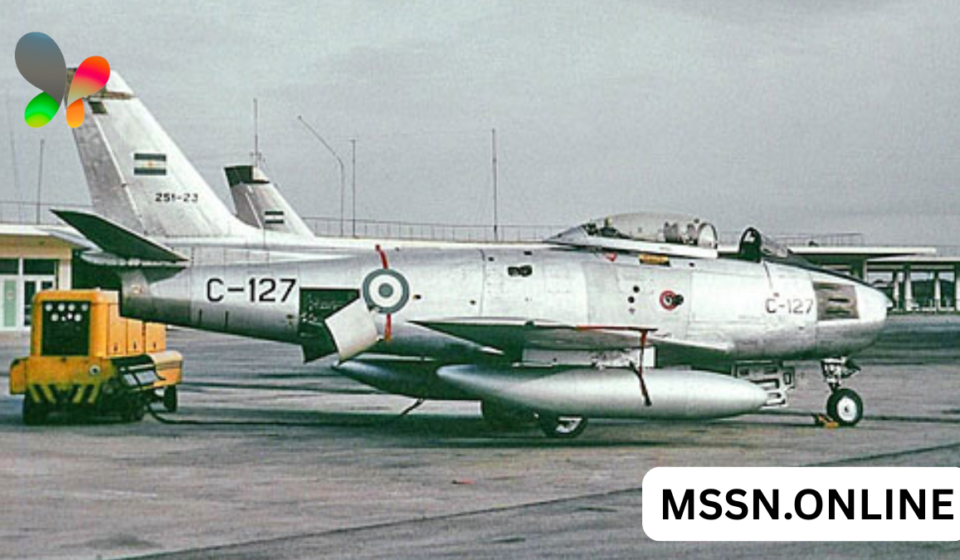

Introduction to the North American F-86F Sabre
When people talk about aircraft that changed the course of aerial warfare, the North American F-86F Sabre almost always enters the conversation. Sleek, powerful, and engineered with a forward-thinking approach, the Sabre represented a giant leap from propeller-driven fighters to the age of jet dominance. It wasn’t just another military aircraft; it was a symbol of technological ambition during one of the most tense periods in modern history.
The F-86F variant, in particular, was the culmination of lessons learned from earlier Sabre models. Engineers refined its aerodynamic profile, improved its weapons systems, and enhanced its engine performance so that it could compete with — and often outperform — its adversaries. Pilots quickly came to respect the aircraft not only for its speed but also for its reliability and responsiveness in combat situations.
What makes the Sabre fascinating is that it managed to combine cutting-edge engineering with practical usability. Many experimental jets of the era were fast but difficult to control. The F-86F struck a balance. It gave pilots confidence, which in turn allowed them to focus on tactics rather than worrying about whether their aircraft would cooperate at high speeds.
Even today, decades after its first flight, aviation historians and enthusiasts still see the Sabre as a milestone. It helped establish design philosophies that continue to influence fighter jets, proving that innovation isn’t just about pushing limits — it’s about creating machines that pilots can trust with their lives.
The Historical Context That Led to the Sabre
To truly understand the importance of the F-86F Sabre, you have to step back into the late 1940s and early 1950s. World War II had just ended, but the peace was uneasy. The Cold War was taking shape, and both the United States and the Soviet Union were racing to develop faster, more capable military aircraft.
The introduction of jet propulsion during World War II had already hinted at the future. Aircraft like Germany’s Me 262 showed the world that propellers were becoming obsolete for frontline fighters. Engineers everywhere began experimenting with swept wings, powerful turbojet engines, and advanced materials that could withstand higher speeds.
North American Aviation recognized that the next war — if it came — would be fought at altitudes and speeds previously unimaginable. Instead of modifying older designs, the company pursued a fresh approach. By studying captured German research on swept-wing aerodynamics, engineers discovered how to reduce drag as aircraft approached the speed of sound.
This research paid off. The Sabre wasn’t just fast; it was built to remain stable near transonic speeds. That capability would prove critical when facing enemy fighters that were equally advanced.
Another factor shaping the Sabre’s development was the growing importance of air superiority. Military planners understood that controlling the skies could determine the outcome of ground conflicts. The aircraft that could climb faster, turn tighter, and fire more accurately would hold the advantage.
When tensions erupted into the Korean War, the Sabre found itself exactly where it was designed to be — on the front lines of a new kind of aerial combat.
Design Philosophy and Engineering Excellence
The F-86F Sabre didn’t become legendary by accident. Every inch of the aircraft reflected deliberate engineering choices aimed at maximizing performance without sacrificing safety.
One of the most noticeable features was its swept wings. Unlike straight-wing aircraft, swept wings delayed the onset of shock waves as the aircraft approached high speeds. This allowed the Sabre to operate efficiently in the transonic region, where airflow begins behaving unpredictably.
Engineers also focused heavily on pilot visibility. The bubble canopy gave aviators a nearly unobstructed view, which was crucial during dogfights. Spotting an enemy even a second earlier could mean the difference between victory and defeat.
The aircraft’s fuselage was carefully streamlined to reduce drag. Small details — like flush riveting and carefully contoured panels — contributed to smoother airflow. These might sound minor, but in aviation, incremental improvements often translate into significant performance gains.
Another highlight was the Sabre’s control system. It responded smoothly to pilot inputs, avoiding the sluggish feel that plagued some early jets. This made it particularly effective in close-range engagements where quick reactions mattered most.
Maintenance crews appreciated the design as well. Access panels were positioned logically, allowing technicians to service the aircraft without excessive downtime. A fighter is only as useful as its availability, and the Sabre excelled in operational readiness.
All these elements combined to create an aircraft that wasn’t just advanced — it was practical, dependable, and built with the realities of combat in mind.
Evolution Toward the F-86F Variant

The Sabre family didn’t appear fully formed overnight. Earlier models helped engineers identify strengths and weaknesses, gradually shaping what would become the F-86F.
Initial variants proved that the swept-wing concept worked, but they also revealed areas for improvement. Pilots wanted better climb rates, more thrust, and enhanced maneuverability. Engineers listened closely, treating pilot feedback as a roadmap for refinement.
The F-86F introduced a more powerful engine that significantly boosted performance. This upgrade allowed the aircraft to accelerate faster and maintain energy during aerial maneuvers — a key advantage in dogfighting scenarios.
Wing design also evolved. The “6-3 wing,” named for its six-inch extension at the root and three-inch extension at the tip, improved lift and reduced drag at higher speeds. The result was an aircraft that could outturn many opponents while retaining excellent stability.
Another improvement came in the form of increased fuel capacity. Longer range meant pilots could patrol larger areas or remain engaged without worrying about running low too quickly.
Weapons systems were refined as well. The Sabre carried six .50 caliber machine guns, a configuration that balanced firepower with weight considerations. Later adaptations allowed for bombs and rockets, expanding the aircraft’s versatility.
By the time the F-86F entered widespread service, it represented the peak of Sabre development — a mature fighter shaped by real-world experience rather than theoretical assumptions.
Performance Capabilities That Impressed Pilots
Ask pilots what they value most in a fighter jet, and you’ll likely hear the same themes: speed, agility, reliability, and predictability. The F-86F delivered on all fronts.
Its top speed approached the sound barrier, a remarkable feat for its era. But raw speed alone doesn’t win battles. The Sabre excelled at energy management, allowing pilots to trade altitude for speed and vice versa with impressive efficiency.
Climb rate was another strength. In combat, reaching a higher altitude quickly provides a tactical edge, enabling pilots to dive into engagements with greater momentum.
What truly set the Sabre apart, though, was how it handled. Many early jets felt unstable at high speeds, but the F-86F maintained composure. Pilots described it as forgiving — an aircraft that wouldn’t punish minor mistakes too harshly.
The aircraft also performed well in dives, maintaining structural integrity even when pushed aggressively. This gave pilots confidence to escape dangerous situations or pursue fleeing opponents.
Range and endurance were respectable, especially with drop tanks. This flexibility made the Sabre suitable for both defensive patrols and offensive missions.
Ultimately, the F-86F wasn’t just a machine; it became an extension of the pilot. When aviators trust their aircraft completely, they can focus on strategy rather than survival — and that trust was one of the Sabre’s greatest achievements.
The Sabre in the Korean War
The Korean War marked the first large-scale conflict where jet fighters faced each other regularly. It was here that the F-86F Sabre truly earned its reputation.
Opposing it was the MiG-15, a formidable aircraft with excellent climb performance and powerful cannons. The skies over “MiG Alley” became the stage for intense aerial duels that would shape fighter tactics for decades.
Despite the MiG’s strengths, the Sabre often held the advantage in maneuverability and pilot visibility. These factors proved crucial during dogfights, where situational awareness could determine the outcome within seconds.
American pilots developed tactics that leveraged the Sabre’s strengths. Instead of engaging in vertical climbs where the MiG excelled, they emphasized turning engagements and coordinated attacks.
The Sabre also benefited from superior training programs. Many pilots were veterans with extensive flight hours, and their experience showed in combat results.
Over time, the F-86 built a strong record, with claims suggesting favorable kill ratios. While historians continue to debate exact numbers, few dispute the aircraft’s effectiveness.
Beyond statistics, the Sabre boosted morale. It reassured pilots that they were flying one of the best fighters available — a psychological advantage that should never be underestimated.
Technology That Pushed Boundaries
What made the F-86F particularly impressive was how it incorporated emerging technologies without becoming overly complicated.
Its radar-assisted gunsight was revolutionary for the time. By calculating lead angles automatically, it increased the probability of hitting fast-moving targets. Pilots no longer had to rely solely on instinct.
Hydraulic controls enhanced responsiveness, especially at higher speeds where manual systems would have required tremendous effort.
The ejection seat represented another life-saving innovation. Though rarely discussed compared to speed or weapons, this feature dramatically improved pilot survival rates.
Materials engineering also played a role. Strong yet lightweight alloys allowed the aircraft to endure stresses that would have damaged earlier designs.
Even the cockpit layout reflected thoughtful planning. Instruments were arranged logically so that pilots could absorb information quickly without becoming overwhelmed.
Together, these technologies didn’t just improve performance — they made high-speed flight more manageable, paving the way for future generations of fighters.
Global Reach and Allied Use
While the Sabre is often associated with the United States, its influence stretched far beyond American borders. Numerous allied nations adopted the aircraft, recognizing its value in maintaining strong air defenses.
Countries across Europe integrated the Sabre into their fleets during the early years of NATO cooperation. For many of these nations, the aircraft represented a significant upgrade from aging propeller-driven fighters.
Canada produced its own version under license, further demonstrating the design’s adaptability. These aircraft served with distinction and reinforced the Sabre’s reputation for reliability.
In Asia, several air forces relied on the Sabre to counter regional threats. Its combination of speed and maneuverability made it suitable for diverse operational environments.
Training programs often accompanied these exports, helping partner nations develop modern air combat doctrines.
The widespread adoption of the Sabre also strengthened diplomatic ties. Military equipment frequently serves as a bridge between allies, and the aircraft became a shared symbol of collective defense.
Even decades later, former Sabre operators often recall the aircraft with admiration, a testament to how deeply it influenced global aviation.
Pilot Experiences and Stories from the Sky
Behind every legendary aircraft are the people who flew it. Pilots frequently described the F-86F as a joy to handle — high praise for a machine designed for combat.
Some recalled their first supersonic dives with a mix of excitement and awe. Feeling the aircraft remain stable as the airframe trembled slightly was a reminder that they were pushing technological boundaries.
Others spoke about the canopy view, which allowed them to track opponents without constantly adjusting their position. That visibility often translated into tactical advantages.
There were also stories of the Sabre bringing pilots home safely despite battle damage. Accounts of aircraft returning with bullet holes or compromised systems reinforced trust in its durability.
Training flights created lasting impressions as well. For many aviators transitioning from propeller aircraft, the Sabre represented a dramatic step forward — faster, smoother, and more responsive.
Perhaps the most telling detail is how many pilots formed emotional connections with the aircraft. They didn’t just fly it; they respected it.
That bond between human and machine is difficult to quantify, yet it often defines aviation history.
Comparing the Sabre to Its Rivals
No aircraft exists in isolation. The F-86F’s legacy becomes even clearer when compared to the fighters it faced.
The MiG-15, for instance, boasted powerful cannons capable of inflicting serious damage. However, those weapons came with trade-offs, including heavier weight and lower ammunition capacity.
The Sabre’s machine guns, while smaller, offered higher firing rates and more sustained bursts. This difference sometimes allowed Sabre pilots to maintain pressure during engagements.
Aerodynamically, both aircraft were advanced, but the Sabre’s handling characteristics often felt more refined. Pilots could push it hard without fearing sudden instability.
Another advantage lay in cockpit ergonomics. Better instrument placement reduced workload, helping pilots stay focused under stress.
Maintenance considerations also mattered. Aircraft that are easier to service can generate more sorties, increasing overall effectiveness.
While debates about which jet was “better” will likely continue forever, most historians agree that the Sabre held its own against a very capable opponent — and often excelled.
Transition Into New Roles
As aviation technology progressed, newer fighters inevitably surpassed the Sabre. Yet retirement from frontline service didn’t mean the end of its usefulness.
Many air forces reassigned the aircraft to training roles. Its predictable handling made it ideal for teaching jet fundamentals to new pilots.
Others adapted it for ground-attack missions, demonstrating the platform’s versatility. Carrying bombs and rockets, the Sabre could support troops effectively when needed.
Some nations kept the aircraft operational well into the later decades of the twentieth century, a testament to its durability.
Meanwhile, civilian operators began acquiring surplus Sabres for airshows. Watching the aircraft roar across the sky became a nostalgic experience for audiences.
Museums also recognized its historical significance. Preserving these jets ensures future generations can appreciate the engineering achievements of the early jet age.
In many ways, the Sabre’s second life proved almost as meaningful as its combat career.
Cultural and Historical Legacy
The F-86F Sabre isn’t just remembered for its technical achievements; it holds a firm place in cultural memory.
During the Cold War, images of sleek jet fighters symbolized national strength and technological prowess. The Sabre often appeared in films, newsreels, and recruitment materials.
Model kits, posters, and aviation magazines further cemented its iconic status. For young enthusiasts, the Sabre represented the cutting edge of flight.
Historians frequently cite it as one of the aircraft that defined the transition into modern aerial warfare. Its success demonstrated that swept-wing jets were not merely experimental — they were the future.
The Sabre also influenced aircraft aesthetics. Its balanced proportions and clean lines set a standard that designers continued to refine.
Even today, spotting a preserved Sabre at an airshow tends to draw crowds. There’s something timeless about its silhouette.
Legacy, after all, isn’t measured only in victories or specifications — it’s measured in lasting impact.
Engineering Lessons That Shaped Future Fighters
Aircraft designers rarely start from scratch. Instead, they build upon proven ideas, and the Sabre offered plenty of them.
Swept-wing configurations became standard for high-speed fighters. Engineers continued experimenting with angles and airfoil shapes, but the Sabre helped validate the concept.
Pilot-centric design also gained traction. Visibility, ergonomic controls, and intuitive instrumentation became priorities rather than afterthoughts.
The integration of radar-assisted targeting foreshadowed increasingly sophisticated avionics. Today’s fighters rely heavily on computerized systems, but the foundation was laid decades earlier.
Structural durability was another takeaway. Designing aircraft that could handle extreme stresses without excessive weight became a central challenge for aerospace engineers.
Perhaps the most important lesson was balance. The Sabre wasn’t the fastest in every category, yet its overall harmony made it exceptionally effective.
Future fighters would chase higher speeds and greater firepower, but many still followed the Sabre’s philosophy: performance must always be paired with control.
Why Aviation Enthusiasts Still Admire the Sabre
Spend a few minutes at any aviation gathering, and you’ll likely hear someone mention the Sabre with admiration. But why does it continue to captivate people so many years later?
Part of the appeal lies in its historical role. It represents a turning point when jet fighters became central to military strategy.
Another factor is its elegance. Unlike some later aircraft that prioritized raw power over aesthetics, the Sabre looked fast even when parked.
Collectors and restorers often describe working on the aircraft as a privilege. Maintaining a piece of aviation heritage carries a sense of responsibility.
Flight demonstrations reinforce this fascination. Seeing the Sabre in motion reminds audiences that engineering can be both functional and beautiful.
There’s also nostalgia involved. For veterans and their families, the aircraft symbolizes courage and sacrifice.
Ultimately, admiration for the Sabre stems from a blend of respect, curiosity, and appreciation for human ingenuity.
Preservation and Restoration Efforts
Keeping historic aircraft operational is no small task. Restoration teams invest countless hours ensuring that Sabres remain safe for display and occasional flight.
Finding replacement parts can be challenging, often requiring custom fabrication. Skilled technicians must combine modern tools with old-school craftsmanship.
Documentation plays a crucial role. Original manuals guide restorers in maintaining authenticity while meeting contemporary safety standards.
Funding is another hurdle. Museums and private collectors rely on donations, sponsorships, and community support to sustain these projects.
Despite these obstacles, the reward is immense. Watching a restored Sabre take to the sky feels like witnessing history come alive.
Educational programs frequently accompany these efforts, helping younger generations understand how aviation evolved.
Preservation ensures that the Sabre remains more than a chapter in textbooks — it stays a tangible reminder of innovation.
The Sabre’s Place in the Evolution of Air Combat
Air combat has transformed dramatically since the 1950s, yet many foundational tactics trace back to the era of the Sabre.
Energy management, formation flying, and coordinated attacks all gained prominence during jet-versus-jet engagements.
The importance of pilot training became undeniable. Superior machines matter, but skilled aviators ultimately determine outcomes.
Technological competition also accelerated. Once one nation introduced an advancement, others quickly followed.
The Sabre’s success highlighted the value of adaptability. Aircraft must evolve alongside changing threats.
Today’s fighters operate with stealth technology and advanced sensors, yet the underlying principles — speed, awareness, and control — remain familiar.
In that sense, the Sabre isn’t just part of history; it’s part of a continuing story.
Conclusion: A Fighter That Defined an Era
The North American F-86F Sabre stands as one of the most influential fighter jets ever built. It emerged during a pivotal moment when aviation was transitioning into uncharted territory, and it proved that thoughtful engineering could conquer new challenges.
From its swept wings to its pilot-friendly cockpit, every aspect reflected a commitment to excellence. It wasn’t merely designed to fly fast; it was designed to win.
Its combat record, global adoption, and enduring reputation all point to a single truth: the Sabre helped shape modern airpower.
Yet perhaps its greatest legacy lies in inspiration. Engineers learned from it, pilots trusted it, and historians continue to study it.
Machines come and go, but a few redefine expectations. The F-86F Sabre is unquestionably one of them — a jet that didn’t just participate in history but helped write it.
FAQs
What made the F-86F Sabre unique among early jet fighters? It combined swept-wing aerodynamics, strong performance, and pilot-friendly handling into a balanced and highly effective design.
Did the F-86F Sabre see combat? Yes, it played a major role during the Korean War in jet-versus-jet engagements.
Who manufactured the F-86F Sabre? It was produced by North American Aviation.
Was the Sabre used outside the United States? Many allied nations operated the aircraft as part of their air forces.
Why is the Sabre still admired today? Its historical importance, elegant design, and influence on future fighters keep it relevant.
What type of weapons did the F-86F carry? It typically featured six .50 caliber machine guns along with optional bombs and rockets.
Is the F-86F still flying today? A few restored examples occasionally appear in airshows and demonstrations.
How fast was the F-86F Sabre? It could approach the speed of sound, making it one of the fastest fighters of its time.
What was the Sabre’s primary mission? Its main role was air superiority, though it could perform ground-attack tasks when needed.
Did the Sabre influence modern aircraft design? Yes, many aerodynamic and ergonomic concepts pioneered in the Sabre shaped future fighter jets.
Also read: Blog WhatUTalkingBoutWillis: A Deep Dive Into a Modern Lifestyle and Parenting Hub