

Introduction to the Jig Borer
A jig borer is one of those machines that quietly transformed the manufacturing world without most people ever noticing. While flashy CNC machines and robotic systems often get the spotlight today, the jig borer remains a symbol of extreme precision. It was designed for one primary purpose: to drill and bore holes with incredibly accurate spacing and alignment. When tolerances must be held within microns rather than millimeters, this machine becomes indispensable.
At its core, a jig borer is a specialized type of machine tool that enables machinists to locate hole centers with exceptional accuracy. Traditional drilling machines can create holes, but maintaining perfect positional accuracy across multiple holes is challenging. The jig borer solves this problem by offering finely calibrated movements along the X and Y axes, allowing operators to position the spindle exactly where it needs to be.
What makes the jig borer especially interesting is its historical significance. Before digital measurement tools became common, manufacturers relied heavily on mechanical precision. Jig borers allowed industries such as aerospace, defense, automotive, and toolmaking to produce interchangeable parts—something that fundamentally changed modern manufacturing.
Another reason the jig borer remains relevant is its versatility. Although originally intended for jig manufacturing, the machine can perform boring, drilling, reaming, countersinking, and even light milling operations. Many toolrooms still use jig borers when extreme accuracy matters more than production speed.
Understanding the jig borer is not just about knowing a machine; it is about appreciating the evolution of precision engineering. Whether you are a machinist, engineering student, factory manager, or simply someone curious about industrial tools, learning how jig borers work provides valuable insight into the backbone of modern manufacturing.
What Is a Jig Borer?
A jig borer is a precision machine tool designed specifically for accurately locating and machining holes. Unlike standard drill presses or milling machines, it emphasizes positional accuracy over heavy material removal. The machine ensures that every hole is placed exactly where the blueprint specifies.
The concept behind the jig borer revolves around coordinate positioning. Instead of relying on manual measurements or marking tools, machinists use calibrated handwheels, digital readouts, or CNC controls to move the worktable. This eliminates cumulative errors that often occur when measuring repeatedly.
One defining feature of jig borers is their extremely rigid construction. The machine base is typically made from high-grade cast iron, which minimizes vibration and thermal distortion. Even slight movement can affect accuracy, so rigidity is not optional—it is essential.
Additionally, jig borers often include precision-ground lead screws and ways. These components allow smooth movement with minimal backlash. Backlash refers to the slight play between mechanical parts, and reducing it is critical for maintaining consistent positioning.
Another standout characteristic is the spindle accuracy. The spindle rotates cutting tools, and in a jig borer, it is engineered to maintain perfect alignment even at high speeds. This ensures holes remain round, straight, and precisely sized.
While modern CNC machines can achieve impressive accuracy, many experienced machinists still respect manual jig borers. They offer a level of tactile control that some professionals find unmatched, especially for delicate toolroom work.
Ultimately, the jig borer is not just another drilling machine. It is a precision instrument built for tasks where even microscopic errors are unacceptable.
History and Evolution of the Jig Borer
The jig borer was developed during a time when manufacturing demanded higher accuracy than traditional machines could provide. Early industrial production struggled with interchangeability because parts often varied slightly in size or position. Engineers needed a machine capable of eliminating these inconsistencies.
The breakthrough came in the early 20th century when manufacturers began designing machines specifically for toolmaking. One of the most influential innovators was the Moore Special Tool Company, which introduced jig borers that set new standards for accuracy. These machines quickly became essential in toolrooms worldwide.
During World War II, jig borers played a crucial role in producing aircraft components, weapons, and navigation equipment. Precision was not just desirable—it was a matter of national security. The ability to create perfectly aligned parts helped ensure machinery performed reliably under extreme conditions.
As technology advanced, jig borers evolved as well. Digital readouts replaced purely mechanical measurement methods, allowing operators to position the spindle more quickly and accurately. Later, CNC integration further enhanced their capabilities.
Despite these advancements, the fundamental purpose of the jig borer has remained unchanged. Accuracy is still the priority, and many older machines continue operating today because their precision rivals modern equipment.
Interestingly, the jig borer also influenced other machine tools. Techniques developed for these machines contributed to improvements in milling machines, coordinate measuring devices, and CNC machining centers.
The story of the jig borer reflects the broader journey of manufacturing—from manual craftsmanship to digitally controlled precision. It is a reminder that innovation often builds upon tools that came before.
Key Components of a Jig Borer
Understanding a jig borer becomes much easier once you break it down into its primary components. Each part plays a critical role in achieving the machine’s renowned accuracy.
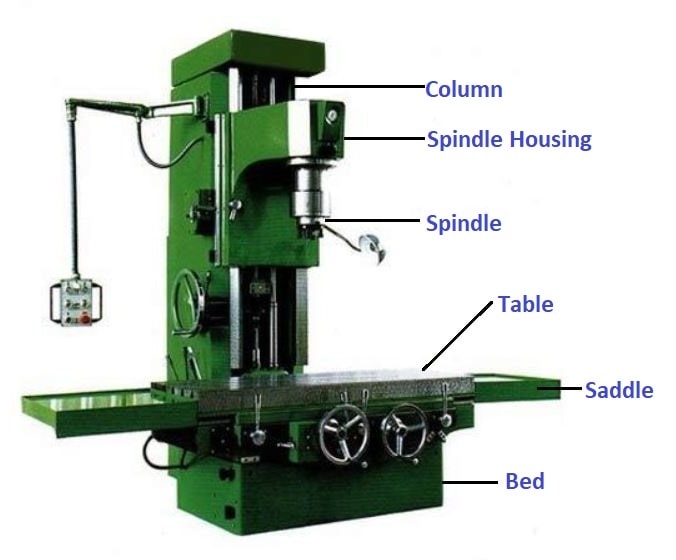
The base serves as the machine’s foundation. Usually constructed from heavy cast iron, it absorbs vibrations and provides stability. Without a solid base, maintaining tight tolerances would be nearly impossible.
Mounted on the base is the worktable. This is where the workpiece is secured using clamps or fixtures. The table moves along the X and Y axes, allowing precise positioning beneath the spindle. Many jig borers feature finely graduated scales or digital displays to assist with measurements.
Another vital component is the column, which supports the spindle assembly. The column must remain perfectly aligned to prevent angular errors during machining. Even a slight tilt could compromise hole accuracy.
The spindle itself is the heart of the machine. It holds the cutting tool and rotates at controlled speeds. High-quality bearings ensure smooth operation, reducing runout and maintaining hole integrity.
Lead screws and guideways enable controlled movement of the table. Precision-ground screws help eliminate backlash, while hardened ways ensure consistent travel.
Many jig borers also include measuring systems such as optical scales or electronic readouts. These tools allow machinists to verify positioning without relying solely on manual calculations.
Finally, lubrication systems help maintain performance by reducing friction and wear. A well-lubricated jig borer can retain its accuracy for decades.
When all these components work together, the result is a machine capable of extraordinary precision—one that continues to earn its place in modern workshops.
How a Jig Borer Works
Operating a jig borer might look straightforward at first glance, but achieving high precision requires careful attention to detail. The process begins with securing the workpiece firmly to the table. Proper clamping is essential because any movement during machining can ruin accuracy.
Once the workpiece is in place, the machinist determines the exact coordinates for each hole. This is typically done using engineering drawings or CAD data. The table is then moved along the X and Y axes until the spindle aligns perfectly with the target location.
Next comes tool selection. Depending on the task, the operator may choose a drill, boring bar, or reamer. Each tool serves a different purpose—drills create holes, boring tools enlarge them, and reamers refine the final diameter.
Spindle speed must also be adjusted based on material type and tool size. Hard metals require slower speeds, while softer materials can be machined faster.
During machining, the operator carefully feeds the tool into the material. Smooth, controlled movement prevents chatter and ensures a clean finish.
After completing one hole, the machinist repositions the table for the next coordinate. This process repeats until all holes are machined.
One of the biggest advantages of the jig borer is repeatability. Once settings are established, the machine can reproduce identical results consistently.
Although modern automation has simplified many processes, skilled operators still play a crucial role. Their understanding of materials, tooling, and measurement ensures the jig borer performs at its best.
Types of Jig Borers
Not all jig borers are identical. Over time, manufacturers have developed different types to suit various machining needs.
The vertical jig borer is the most common design. Its spindle is positioned vertically, making it ideal for drilling and boring downward into a workpiece. This configuration offers excellent visibility and control.
Horizontal jig borers, while less common, are useful for machining larger components. Their spindle extends horizontally, allowing access to areas that might be difficult to reach with a vertical machine.
Manual jig borers rely entirely on operator skill. These machines are often found in toolrooms where craftsmanship and precision are highly valued.
CNC jig borers combine traditional accuracy with digital control. Operators can program coordinates, reducing setup time and minimizing human error.
There are also high-speed jig borers designed for lighter materials and rapid operations. These machines prioritize efficiency without sacrificing accuracy.
Some manufacturers produce combination machines that integrate jig boring with milling capabilities. These hybrid models provide greater flexibility for workshops handling diverse projects.
Choosing the right type depends on factors such as production volume, material type, and required tolerances.
Regardless of design, every jig borer shares the same mission: delivering unmatched positional accuracy.
Advantages of Using a Jig Borer
One of the biggest advantages of a jig borer is precision. Few machines can match its ability to position holes with such tight tolerances.
Another benefit is surface quality. Because the machine minimizes vibration, the resulting holes are smooth and accurate.
Repeatability is equally important. Once properly configured, a jig borer can produce identical parts repeatedly, which is essential for manufacturing consistency.
The machine also reduces reliance on manual marking and measurement. This saves time while lowering the risk of human error.
Durability is another strong point. Many jig borers remain operational for decades with proper maintenance.
Versatility adds to their appeal. Beyond drilling, they can handle boring, reaming, and light milling tasks.
From a financial perspective, investing in a jig borer can be worthwhile for toolrooms and precision workshops. The reduction in scrap and rework often offsets the initial cost.
Finally, the machine enhances overall product quality. Better hole alignment leads to improved assembly and longer-lasting components.
For industries where accuracy defines success, the jig borer is more than helpful—it is essential.
Common Applications of Jig Borers
Jig borers are widely used in industries where precision cannot be compromised. Tool and die manufacturing is perhaps the most traditional application. Creating jigs, fixtures, and templates demands exact hole placement.
The aerospace sector also relies heavily on precision machining. Aircraft components must fit perfectly, and jig borers help achieve that level of accuracy.
Automotive manufacturers use these machines when producing engine parts, transmission components, and braking systems. Even minor misalignment could affect performance.
Medical equipment production is another area where jig borers shine. Surgical instruments and diagnostic devices require flawless construction.
Electronics manufacturing benefits as well. Precision holes are necessary for circuit boards and specialized housings.
Research laboratories often use jig borers for experimental equipment. Custom setups frequently demand unique components with tight tolerances.
Defense contractors depend on precision machining for guidance systems and mechanical assemblies.
Even small workshops find value in jig borers when handling high-accuracy projects.
The wide range of applications demonstrates just how versatile and important this machine remains.
Jig Borer vs Milling Machine
At first glance, a jig borer and a milling machine might appear similar. Both use rotating tools and movable tables, but their priorities differ significantly.
A milling machine focuses on material removal. It is built to cut slots, contours, and surfaces efficiently.
The jig borer, on the other hand, prioritizes positional accuracy. While it can remove material, its real strength lies in precise hole placement.
Milling machines typically handle heavier cuts, whereas jig borers excel at delicate operations.
Another difference is measurement capability. Jig borers often include advanced positioning systems that milling machines may lack.
However, modern CNC mills have narrowed the gap. Some high-end models can achieve impressive accuracy.
Still, many machinists prefer jig borers for ultra-precise work because they were engineered specifically for that purpose.
Choosing between the two depends on project requirements. If accuracy outweighs speed, the jig borer is usually the better choice.
Understanding these distinctions helps manufacturers select the right tool for the job.
Maintenance and Care for Long-Term Accuracy
Maintaining a jig borer is not complicated, but it requires consistency. Regular cleaning should be the first priority. Dust, chips, and debris can interfere with precision components.
Lubrication is equally important. Properly oiled guideways and screws reduce wear and ensure smooth movement.
Periodic calibration helps verify that measurements remain accurate. Even robust machines can drift slightly over time.
Temperature control also matters more than many people realize. Extreme fluctuations can cause metal components to expand or contract.
Operators should inspect tooling regularly. Worn tools can compromise hole quality and strain the spindle.
Keeping the machine level is another crucial step. Uneven floors may introduce alignment errors.
Software updates are important for CNC models, ensuring optimal performance and security.
Finally, training operators properly can extend machine life significantly. Skilled handling prevents unnecessary stress on components.
With attentive care, a jig borer can remain reliable for generations.
Future of Jig Boring Technology
The future of jig boring is closely tied to broader manufacturing trends. Automation continues to reshape workshops, and jig borers are no exception.
CNC integration has already improved efficiency, but newer systems are pushing accuracy even further. Advanced sensors can detect minute deviations and adjust operations in real time.
Artificial intelligence may soon assist machinists by optimizing cutting parameters automatically.
Hybrid machines are becoming more common, blending jig boring with milling and inspection capabilities.
Sustainability is another emerging focus. Manufacturers are designing machines that consume less energy while maintaining performance.
Digital twins—virtual models of physical machines—could allow engineers to simulate operations before cutting any material.
Despite these innovations, the core philosophy remains unchanged: precision above all else.
Rather than becoming obsolete, the jig borer is evolving alongside modern technology.
Its continued relevance proves that accuracy will always be a cornerstone of manufacturing.
Conclusion
The jig borer stands as a testament to engineering excellence. While it may not always capture attention like newer technologies, its impact on manufacturing is undeniable.
From toolrooms to aerospace facilities, this machine has enabled industries to achieve levels of precision once thought impossible.
Its rigid construction, advanced positioning systems, and reliable spindle performance make it uniquely suited for high-accuracy work.
Even in an era dominated by CNC machining centers, the jig borer retains a respected place in workshops around the world.
Understanding how it works, where it excels, and how to maintain it provides valuable insight for anyone involved in manufacturing.
As technology advances, the jig borer will likely continue adapting rather than disappearing.
In the end, precision is not just a feature—it is a necessity. And few machines embody that principle better than the jig borer.
FAQs
What is a jig borer used for?
A jig borer is used to drill and bore extremely accurate holes with precise spacing and alignment.
Is a jig borer still relevant today?
Yes, it remains essential for industries that require ultra-high precision machining.
How is a jig borer different from a drill press?
A jig borer offers far greater positional accuracy and measurement capability than a standard drill press.
Can a jig borer perform milling operations?
Yes, it can handle light milling tasks, although it is primarily designed for precision hole work.
Do modern workshops still use manual jig borers?
Many toolrooms continue using them because of their reliability and unmatched accuracy.
What industries benefit most from jig borers?
Aerospace, automotive, medical, defense, and toolmaking industries rely heavily on jig boring.
How accurate is a jig borer?
High-quality jig borers can achieve tolerances within a few microns.
Are CNC jig borers better than manual ones?
CNC models improve efficiency and reduce human error, but manual machines still excel in skilled hands.
What materials can be machined on a jig borer?
They can machine metals, plastics, and certain composites depending on tooling.
How long does a jig borer last?
With proper maintenance, a jig borer can remain accurate and functional for decades.