

Ignition Angle: The Complete Expert Guide to Understanding Timing, Performance, and Engine Efficiency

Introduction to Ignition Angle
Ignition angle is one of those technical concepts that quietly determines how well an engine performs, yet many people outside the automotive or engineering world rarely hear about it. Whether you are dealing with a gasoline engine in a family car, a high-performance racing machine, or even industrial combustion systems, ignition angle plays a decisive role in efficiency, power delivery, and reliability. Simply put, it refers to the exact point in the engine cycle when the spark plug fires to ignite the air-fuel mixture inside the combustion chamber.
At first glance, ignition angle might seem like a tiny adjustment measured in degrees, but its impact is enormous. A slight shift forward or backward can change how smoothly your engine runs, how much fuel it consumes, and even how long it lasts. Engineers spend countless hours calibrating ignition timing because the difference between optimal combustion and inefficient burning often comes down to just a few degrees of crankshaft rotation.
Understanding ignition angle is not just for mechanics or automotive engineers. Drivers interested in fuel economy, performance enthusiasts chasing horsepower, and students exploring mechanical engineering all benefit from grasping this concept. Once you understand how ignition timing interacts with engine speed, load, and temperature, you start seeing the engine less as a mysterious machine and more as a precisely synchronized system.
Another reason ignition angle deserves attention is the shift toward smarter engines. Modern vehicles rely on electronic control units that constantly adjust ignition timing in real time. This means ignition angle is no longer static—it evolves with driving conditions, altitude, fuel quality, and even weather. That adaptability is what allows modern engines to deliver both power and efficiency without sacrificing environmental responsibility.
In this guide, we will explore ignition angle from the ground up. We will break down the science behind combustion, explain why timing matters, examine how engineers calculate the ideal angle, and look at the technologies that make modern ignition systems incredibly precise. By the end, you will not only understand ignition angle but also appreciate why it remains one of the most critical parameters in engine design.
What Is Ignition Angle? A Clear Technical Explanation
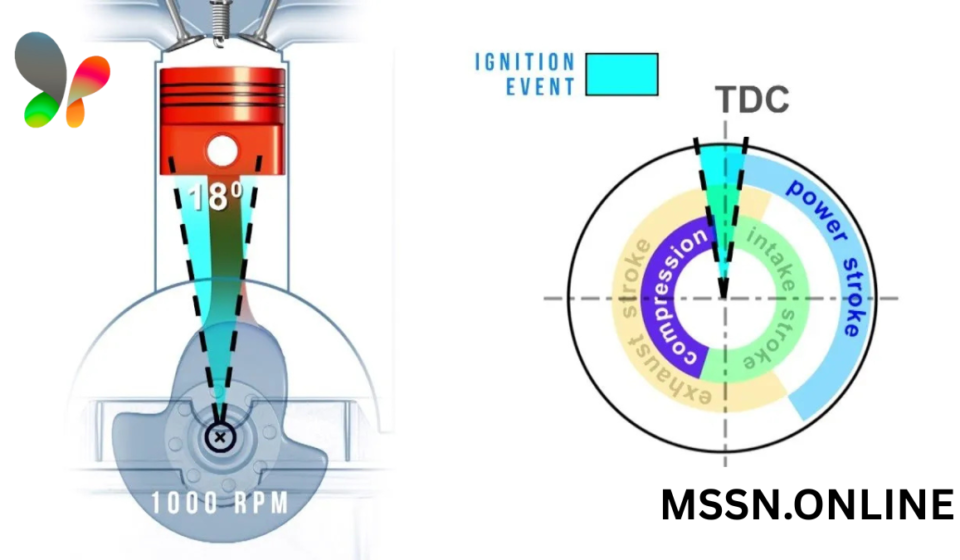
Ignition angle refers to the number of degrees before the piston reaches top dead center (TDC) that the spark plug fires in a spark-ignition engine. Top dead center is the highest point the piston reaches during its compression stroke. Instead of waiting for the piston to reach this exact point, engineers ignite the mixture slightly earlier so that the combustion process builds pressure just as the piston begins moving downward.
The reason for this early ignition lies in the physics of combustion. When the spark plug fires, the air-fuel mixture does not explode instantly. Instead, a flame front travels across the combustion chamber at a measurable speed. If ignition happened exactly at TDC, the pressure peak would occur too late, reducing the force applied to the piston and ultimately lowering engine efficiency. By advancing the ignition angle, engineers ensure that maximum pressure occurs at precisely the right moment.
Ignition angle is usually expressed in degrees of crankshaft rotation. For example, if an engine fires at 15 degrees before top dead center (15° BTDC), it means the spark occurs when the crankshaft is 15 degrees away from completing the compression stroke. Different engines require different angles depending on their design, compression ratio, and operating conditions.
It is important not to confuse ignition angle with injection timing in diesel engines. Diesel engines rely on compression rather than spark plugs, so the fuel injection moment determines combustion timing. However, the underlying principle remains similar—combustion must align with piston movement for optimal energy transfer.
Another interesting aspect is that ignition angle is dynamic rather than fixed in most modern engines. Older mechanical distributors used centrifugal weights and vacuum systems to adjust timing, but today’s vehicles rely on digital sensors and microprocessors. These systems monitor engine speed, throttle position, and knock signals to determine the best possible timing hundreds of times per second.
When you think about it, ignition angle is really about choreography. Every component inside the engine must move in harmony, and the spark must occur at the perfect instant. Too early, and the engine fights itself. Too late, and valuable energy is wasted. Getting it right is what transforms controlled combustion into usable power.
The Science Behind Combustion and Timing

To truly appreciate ignition angle, you need to understand the science of combustion. Combustion is a chemical reaction between fuel and oxygen that releases heat energy. Inside an engine cylinder, this reaction must occur rapidly but in a controlled manner. The goal is not a violent explosion but a smooth pressure rise that pushes the piston downward.
When the spark plug ignites the mixture, a tiny kernel of flame forms at the electrode. This flame spreads outward in all directions until it consumes the entire mixture. The speed of this flame depends on factors such as mixture ratio, turbulence, temperature, and pressure. Engineers design combustion chambers to encourage turbulence because swirling air helps the flame travel faster and more evenly.
Timing becomes critical because the piston is constantly moving. During the compression stroke, the piston travels upward, squeezing the mixture into a smaller space. If ignition happens too early, pressure builds while the piston is still rising. This creates resistance and can lead to knocking, a harmful condition where uncontrolled combustion causes shock waves inside the cylinder.
On the other hand, if ignition occurs too late, the piston will already be descending before peak pressure develops. That means less force is applied to the piston, reducing torque and increasing fuel consumption. Late timing can also cause higher exhaust temperatures, which may damage engine components over time.
Another scientific principle at play is the relationship between pressure and mechanical advantage. The crankshaft converts the piston’s linear motion into rotational force. Maximum efficiency occurs when peak pressure pushes the piston shortly after TDC, typically around 15 to 20 degrees into the power stroke. This positioning allows the crankshaft to leverage the force effectively.
Temperature also influences combustion speed. Warmer mixtures burn faster, which may require less ignition advance. Conversely, colder conditions slow down the flame, prompting the system to ignite earlier. This is one reason engines behave differently during cold starts compared to fully warmed operation.
Ultimately, ignition angle is about controlling a chain reaction that unfolds in milliseconds. Engineers must anticipate how the flame will behave and trigger it early enough so that everything aligns perfectly with the engine’s mechanical motion.
Why Ignition Angle Matters for Engine Performance
Ignition angle is directly tied to how much power an engine produces. When timing is optimized, combustion pressure pushes the piston with maximum effectiveness, translating more of the fuel’s energy into mechanical work. This results in stronger acceleration, smoother operation, and better responsiveness.
Performance enthusiasts often adjust ignition timing to extract additional horsepower. Advancing the timing slightly can improve throttle response because the engine produces more torque at lower speeds. However, this must be done carefully. Too much advance increases the risk of knocking, which can damage pistons, valves, and bearings.
Fuel efficiency is another area where ignition angle plays a significant role. Proper timing ensures that the fuel burns completely, leaving minimal unburned hydrocarbons. This not only saves money at the pump but also reduces emissions. In fact, many emission control strategies depend on precise ignition timing to maintain cleaner exhaust output.
Engine longevity also benefits from correct ignition timing. When combustion occurs at the right moment, stress on internal components is minimized. The piston, connecting rod, and crankshaft experience smoother force transitions, reducing wear and tear. Poor timing, by contrast, can create excessive heat and pressure that shorten engine life.
Drivers may not always realize it, but ignition timing influences everyday comfort. A well-timed engine runs quietly and smoothly, while incorrect timing often leads to rough idling, hesitation, or pinging sounds. Modern vehicles automatically adjust timing to prevent these issues, making driving more enjoyable.
Even turbocharged engines rely heavily on ignition control. Because forced induction increases cylinder pressure, the margin for error becomes smaller. Advanced engine management systems carefully balance boost levels and ignition timing to deliver impressive power without compromising safety.
In essence, ignition angle acts as a performance dial. When tuned correctly, it unlocks the engine’s full potential. When neglected, it can quietly undermine efficiency and reliability.
Factors That Influence Ignition Angle
Several variables determine the ideal ignition angle for any engine, and understanding them helps explain why timing is rarely static. One of the most important factors is engine speed. As RPM increases, the piston moves faster, leaving less time for combustion. To compensate, the spark must occur earlier so that pressure still peaks at the optimal moment.
Engine load is another critical element. When you press the accelerator, more air and fuel enter the cylinder, increasing pressure and density. This mixture often burns faster, which may require slightly less advance compared to lighter loads. Modern engine control units constantly evaluate load conditions to adjust timing accordingly.
Fuel quality has a surprisingly strong impact as well. Higher-octane fuels resist knocking better, allowing for more advanced timing. This is why performance vehicles often recommend premium fuel—it enables more aggressive ignition strategies that improve power output. Lower-octane fuel, on the other hand, may force the engine to retard timing to prevent damage.
Compression ratio also shapes ignition requirements. Engines with higher compression generate more heat and pressure, accelerating the combustion process. While this can improve efficiency, it also demands careful timing control to avoid pre-ignition or detonation.
Temperature plays a dual role. Hot engines tend to ignite mixtures more easily, while cold engines need additional advance. That is why many vehicles adjust timing during warm-up to maintain smooth operation.
Altitude introduces another variable. At higher elevations, thinner air reduces oxygen availability, slowing combustion. Engines often compensate by altering timing to maintain consistent performance despite the reduced air density.
Finally, engine design itself matters. Combustion chamber shape, spark plug placement, and airflow patterns all influence how quickly the flame spreads. Engineers consider these details during development to determine baseline ignition maps.
These factors highlight why ignition angle is not a one-size-fits-all measurement. It is a carefully balanced parameter shaped by physics, environment, and engineering choices.
Advanced vs Retarded Timing: Understanding the Difference
When discussing ignition angle, two terms frequently appear: advanced timing and retarded timing. These phrases describe whether the spark occurs earlier or later relative to top dead center. Understanding the distinction is essential for diagnosing engine behavior and optimizing performance.
Advanced timing means the spark fires earlier in the compression stroke. This approach allows more time for the flame to develop, ensuring that peak pressure aligns with the piston’s downward movement. Moderate advancement typically improves power and efficiency, especially at higher speeds.
However, excessive advance can cause knocking. This happens when pressure rises too quickly, creating shock waves that collide within the cylinder. The metallic pinging sound associated with knock is more than just noise—it signals potentially destructive forces acting on engine components.
Retarded timing, by contrast, delays the spark closer to or even after TDC. While this reduces the risk of knocking, it also means combustion may occur too late to extract maximum energy. Engines with overly retarded timing often feel sluggish and consume more fuel.
Interestingly, retarded timing is sometimes used intentionally. During engine startup or under certain emission control strategies, slightly delayed ignition can help manage temperature and reduce pollutants. Turbocharged engines may also retard timing under heavy boost to protect internal parts.
The art of ignition tuning lies in finding the sweet spot between these extremes. Engineers aim for the most advanced timing possible without triggering knock. Modern knock sensors make this balancing act far easier by detecting vibrations and signaling the control unit to adjust timing instantly.
In practical terms, think of advanced timing as leaning toward performance and retarded timing as leaning toward safety. The best engines seamlessly transition between the two depending on driving conditions.
How Modern Engines Control Ignition Angle
Gone are the days when mechanics manually adjusted distributors with simple tools. Today’s engines rely on sophisticated electronics to manage ignition angle with remarkable precision. At the center of this system is the engine control unit, often referred to as the ECU.
The ECU gathers data from multiple sensors, including crankshaft position sensors, camshaft sensors, throttle position sensors, and knock detectors. Using this information, it calculates the ideal ignition angle for each cylinder in real time. This process happens so quickly that adjustments can occur hundreds of times per second.
Crankshaft sensors play a particularly vital role because they provide the exact rotational position of the engine. Without this data, accurate timing would be impossible. Meanwhile, knock sensors act as a protective mechanism. If they detect vibrations associated with detonation, the ECU immediately retards timing to safeguard the engine.
Another innovation is adaptive learning. Many modern ECUs store historical data about driving patterns and fuel quality. Over time, the system refines its timing strategy to better match real-world conditions. This means your engine becomes smarter the longer you drive it.
Drive-by-wire technology further enhances ignition control. Because the accelerator pedal communicates electronically rather than mechanically, the ECU can coordinate throttle input, fuel injection, and ignition timing simultaneously. The result is smoother acceleration and improved efficiency.
Hybrid vehicles and advanced combustion engines take things even further by integrating ignition timing with electric assistance or variable compression systems. These technologies push the boundaries of what internal combustion engines can achieve.
Despite all this automation, the underlying goal remains unchanged: ignite the mixture at exactly the right moment. Technology has simply made that goal easier to achieve with consistency and accuracy.
Common Ignition Timing Problems and Their Symptoms
Even with modern technology, ignition timing issues can still arise. Recognizing the warning signs early can prevent costly repairs and keep your engine running smoothly.
One of the most noticeable symptoms is engine knocking. This metallic ping often occurs during acceleration and suggests that combustion is happening too early. While occasional light knock may not cause immediate harm, persistent knocking should never be ignored.
Hard starting is another potential indicator. If the spark timing is off, the engine may struggle to fire properly, especially in cold conditions. Drivers might notice extended cranking before the engine finally comes to life.
Poor fuel economy frequently accompanies incorrect timing. When combustion is not optimized, more fuel is required to produce the same amount of power. Over time, this inefficiency adds up.
Overheating can also be linked to timing problems. Late combustion allows more heat to escape into the exhaust system, raising overall engine temperatures. This extra heat can strain cooling components and reduce reliability.
Drivers sometimes report sluggish acceleration or uneven idling when timing is misaligned. These symptoms may feel subtle at first but often worsen if left unaddressed.
Fortunately, onboard diagnostics make troubleshooting easier than ever. Mechanics can connect scanning tools to identify timing irregularities and sensor faults quickly. In many cases, recalibrating the ECU resolves the issue without extensive repairs.
Staying attentive to these signs ensures that ignition angle continues to support performance rather than undermine it.
Ignition Angle in High-Performance and Racing Engines
In the world of motorsports, ignition angle becomes a powerful tuning tool. Racing engines operate under extreme conditions where every fraction of a second matters. Engineers push timing closer to the threshold of knocking to extract maximum horsepower.
Unlike everyday vehicles, race cars often run on high-octane or specialized fuels that tolerate aggressive timing. This allows engineers to advance the spark further than would be safe in a standard engine. The reward is sharper throttle response and explosive acceleration.
Data logging systems monitor engine behavior throughout a race, providing insights that help teams refine timing strategies. Adjustments may be made based on track temperature, humidity, and even tire grip. It is a dynamic process that blends science with intuition.
Another fascinating aspect is cylinder-specific tuning. Some advanced racing setups adjust ignition timing individually for each cylinder to account for slight variations in airflow or temperature. This level of precision ensures balanced power delivery.
However, the margin for error is razor thin. Too much advance can destroy an engine in moments, which is why professional teams rely on experienced engineers and sophisticated monitoring equipment.
The lessons learned in racing often trickle down to consumer vehicles. Technologies such as knock detection and adaptive timing were refined on the track before becoming standard in road cars.
Ultimately, racing highlights the true potential of ignition angle. When mastered, it transforms raw fuel into breathtaking performance.
The Future of Ignition Timing Technology
As the automotive industry evolves, ignition timing continues to adapt alongside new technologies. Even with the rise of electric vehicles, internal combustion engines remain relevant, especially in hybrid systems. Engineers are exploring smarter ways to control ignition for improved efficiency and lower emissions.
Artificial intelligence is beginning to influence engine management. Future ECUs may use machine learning to predict optimal timing based on driving habits and environmental data. This could lead to engines that constantly self-optimize without requiring manual updates.
Variable compression engines are another promising development. By altering the compression ratio on the fly, these engines can adjust ignition requirements dynamically, delivering both power and economy depending on demand.
Alternative fuels also present new challenges and opportunities. Hydrogen and synthetic fuels burn differently than traditional gasoline, requiring fresh approaches to timing strategies. Researchers are already experimenting with ignition systems tailored to these fuels.
Laser ignition is an emerging concept that replaces traditional spark plugs with focused light pulses. This method could ignite mixtures more precisely and evenly, potentially improving combustion efficiency.
While the future may bring radical changes, the core principle remains timeless: combustion must occur at exactly the right moment. Ignition angle will continue to serve as the heartbeat of controlled power generation.
Conclusion
Ignition angle might seem like a small technical detail, but it is truly one of the defining factors behind engine performance, efficiency, and durability. From the earliest mechanical distributors to today’s intelligent electronic systems, the quest for perfect timing has shaped the evolution of internal combustion engines.
By igniting the air-fuel mixture just before the piston reaches top dead center, engineers harness the full potential of combustion. This delicate balance ensures that pressure peaks at the ideal moment, translating chemical energy into smooth mechanical force.
We have seen how ignition timing influences everything from horsepower and fuel economy to emissions and engine lifespan. We have explored the variables that shape timing decisions and the technologies that make modern engines remarkably adaptive.
For drivers, understanding ignition angle brings a new appreciation for the complexity hidden beneath the hood. For engineers, it remains a field of constant refinement and innovation. And for the future of transportation, it continues to represent the intersection of physics, technology, and precision.
In the end, ignition angle is more than just a measurement in degrees—it is the art of timing energy itself.
FAQs
What is ignition angle?
Ignition angle is the number of crankshaft degrees before top dead center when the spark plug ignites the air-fuel mixture.
Why is ignition timing important?
Proper timing ensures maximum engine power, better fuel efficiency, and reduced mechanical stress.
What happens if ignition timing is too advanced?
Excessively advanced timing can cause engine knocking and potential internal damage.
What does retarded ignition timing do?
Retarded timing delays combustion, which may reduce power but can help prevent knocking.
Do modern cars adjust ignition angle automatically?
Yes, most modern vehicles use an ECU and sensors to optimize timing in real time.
Can bad fuel affect ignition timing?
Lower-octane fuel may force the engine to retard timing to avoid detonation.
Is ignition angle the same in diesel engines?
Diesel engines control combustion through injection timing rather than spark ignition.
How can I tell if my ignition timing is off?
Symptoms include knocking sounds, poor fuel economy, hard starting, and sluggish acceleration.